
Research & Education
Browsing page 349 of AI tools for Research & Education. Sorted by confidence score — our independent quality rating.

Calculator Star AI
Calculator Star is an intelligent calculator app designed for iOS that combines traditional calculator functionality with advanced voice-powered AI assistance. Users can ask math questions in plain English, such as "If I work 8 hours a day at $25 per hour, how much will I earn in a week?", and receive answers with step-by-step explanations. The app handles a wide range of calculations including basic arithmetic, percentages, time calculations, currency conversions, unit conversions, and word problems. It also features a calculation history, allowing users to review previous problems and their logic. While basic functions work offline, the voice AI features require an internet connection for processing. Privacy is a priority, with voice processing done securely and recordings never stored.
AI Hub Albania
AI Hub Albania is a non-profit organization dedicated to fostering an open, collaborative AI community. It serves as a platform for AI enthusiasts, researchers, and professionals to connect, learn, and innovate. The hub provides resources, events, and opportunities for members to engage in discussions, contribute to cutting-edge research, and access tools designed to shape the future of AI. Key activities include organizing AI meetups, hackathons, public lectures, policy discussions, and workshops focused on AI education and innovation. AI Hub also supports AI-driven startups with mentorship, funding opportunities, and networking, aiming to drive meaningful progress and ethical AI development.

PDFSeek
PDFSeek is an AI-powered document management tool designed to enhance productivity for students, researchers, and professionals. It allows users to upload PDF documents and interact with them through AI chat, summarization, and translation features. The platform supports multi-language translation, intelligent recognition of multi-column content, and the ability to retain and translate text within charts and formulas. Users can organize multiple PDFs into folders and chat with them simultaneously, with built-in citations linking responses directly to the original PDF content. PDFSeek aims to simplify document interaction, making it easier to understand complex information and extract key insights without extensive reading.
pytorch-original-transformer
pytorch-original-transformer offers a PyTorch implementation of the original transformer model by Vaswani et al., designed to facilitate learning and experimentation with transformers. The repository includes a `playground.py` file with visualizations for complex concepts like positional encodings and custom learning rate schedules, making them easier to grasp. It also provides pretrained models on the IWSLT dataset for English-German machine translation, demonstrating practical application. The tool supports training new models and inference, with well-commented code and setup instructions for a smooth user experience. It's an excellent resource for anyone looking to understand and work with the foundational transformer architecture.

BiHilo
BiHilo Academy offers specialized training and career support for science graduates aiming to enter the medical and pharmaceutical sectors. The program includes 12 practical modules covering sales, marketing, regulatory affairs, quality control, and more, designed to equip students with industry-specific language and skills. Participants receive individual tutoring, career coaching, and assistance with CV optimization and LinkedIn profiles. BiHilo also provides real-world insights from professionals working in leading medical companies and offers support until employment, including exclusive job offers and interview feedback. The curriculum is structured to help graduates identify suitable roles and gain the competencies needed for entry-level positions with competitive salaries.
Machine-learning-learning-notes
Machine-learning-learning-notes is an open-source GitHub repository dedicated to providing comprehensive study notes for Zhou Zhihua's influential 'Machine Learning' book, often referred to as the 'Watermelon Book'. This resource meticulously details different types of machine learning algorithms, including supervised, unsupervised, semi-supervised, reinforcement learning, ensemble methods, dimensionality reduction, and feature selection. The notes are designed to clarify complex concepts, offering insights and expanded knowledge points to help new learners grasp the material effectively. It serves as a valuable companion for anyone studying machine learning, particularly those working through the 'Watermelon Book', and includes references to other classic works like Li Hang's 'Statistical Learning'.
Andrew-Ng-Deep-Learning-notes
Andrew-Ng-Deep-Learning-notes is an open-source GitHub repository offering detailed notes and practice code for Andrew Ng's renowned Deep Learning course. The notes are primarily in Chinese, making it a valuable resource for Chinese-speaking learners. The repository includes completed assignments, allowing users to review and understand practical applications of the course material. While it doesn't guarantee to cover every aspect of the course, it serves as an excellent supplementary learning tool. Users are encouraged to contribute by raising issues or submitting pull requests for any identified inaccuracies, fostering a collaborative learning environment.
python-Machine-learning
python-Machine-learning is an open-source GitHub repository dedicated to machine learning algorithms and projects. It serves as a valuable resource for individuals looking to gain practical experience in machine learning, offering a collection of code examples from various projects and competitions. The repository is maintained by Mryangkaitong and encourages contributions from the community. It also provides links to related blogs and a WeChat official account for in-depth explanations and updates on the projects, making it a comprehensive learning hub for machine learning enthusiasts and practitioners.

Creax
Creax is an innovation agency with over 25 years of experience, partnering with global innovators to identify future playing fields and address complex challenges. The agency offers services across three key areas: Visionary Roadmaps to sharpen innovation journeys, Smart Opportunities to uncover new markets and applications through emerging trends, and Sustainable Solutions to rethink products and processes with data-driven insights. Creax emphasizes a unique methodology that combines continuous data analysis with creative exploration, helping clients develop next-gen solutions, improve innovation processes, reduce risk, and accelerate progress. They have successfully completed over 1,250 projects across diverse industries.
3D-GRAND: Densely-Grounded 3D-LLM
3D-GRAND is a Densely-Grounded 3D-LLM designed to bridge the gap between natural language descriptions and 3D environments. Users can select a 3D scene and input a query to describe specific objects or locations. The tool then provides visual highlights of the relevant objects directly overlaid on the 3D model, offering a unique way to interact with and understand 3D data through text. This AI tool facilitates research in 3D understanding and grounding, making complex 3D scenes more accessible and interpretable through language-based interaction. It is available as a Hugging Face Space, indicating its potential for academic and research-oriented applications.
3DOI
3DOI is a research tool hosted on Hugging Face Spaces, designed for the academic exploration of 3D object interaction. The project focuses on understanding how 3D objects behave and interact when presented with only a single image as input. This tool is primarily intended for researchers and academics in the field of computer vision and artificial intelligence who are working on problems related to 3D reconstruction, scene understanding, and object manipulation from limited visual data. While the current live website indicates a runtime error preventing full functionality, the underlying goal is to provide a platform for experimentation and development in this specialized area.
ClearSKY Vision
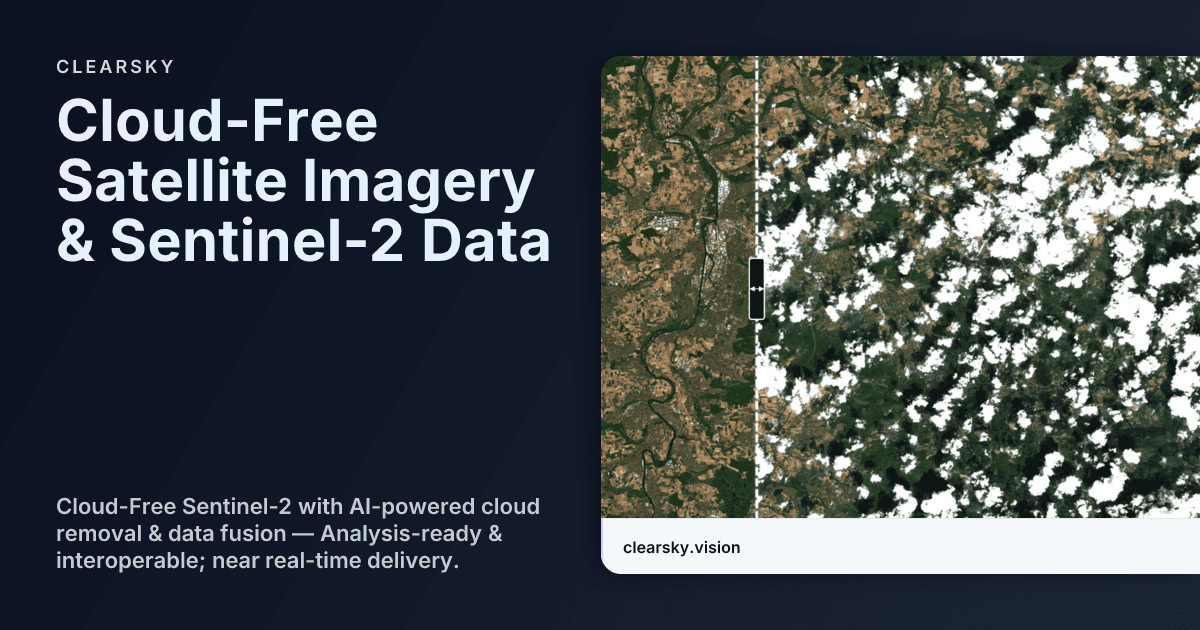
ClearSKY Vision offers cloudless Sentinel-2 satellite imagery, leveraging AI for cloud removal and data fusion. It integrates optical and SAR data from Sentinel-1 and Sentinel-2 satellites to reconstruct cloud-covered areas, clean optical pixels, and provide harmonized, analysis-ready images. This tool delivers frequent, consistent data at 10m resolution, available in Cloud Optimized GeoTIFF (COG) format, with options for TOA or BOA products. It supports flexible ordering via GeoJSON, WKT, or tiles, catering to agriculture, forestry, and environmental monitoring, ensuring uninterrupted insights even under persistent cloud cover.
reward-bench
RewardBench is an open-source benchmark and evaluation tool specifically designed for assessing the capabilities and safety of reward models, including those utilizing Direct Preference Optimization (DPO). The repository offers common inference code compatible with various reward models such as Starling, PairRM, OpenAssistant, and DPO. It ensures fair evaluation through standardized dataset formatting and testing procedures. Additionally, RewardBench includes robust analysis and visualization tools to help researchers and developers interpret results effectively. It supports quick evaluation of any reward model on any preference set, with features for logging model outputs and accuracy scores, and options for generative models (LLM-as-judge) and DPO models. The platform also facilitates contributing models to a public leaderboard and offers offline ensemble testing.

Megathil
Megathil is an AI-driven career accelerator designed to help individuals land their dream jobs through cutting-edge upskilling resources. The platform provides personalized, interactive, and effective learning experiences that adapt to unique needs and goals. Users can practice unlimited mock interviews with realistic, job-specific questions and receive instant AI-based feedback on their responses, including detailed analytics on answers, body language, and vocal delivery. Megathil also offers a gamified learning experience with points, badges, and leaderboards, covering essential skills like critical thinking and communication. Comprehensive resources, skill development modules, and real-time analytics further enhance the learning journey, empowering users to confidently overcome interview challenges.

Beatz: AI Song・Cover Generator
Conlan is a dynamic team of experienced developers specializing in innovative mobile applications powered by artificial intelligence. Their product EveryScan transforms smartphones into sophisticated visual encyclopedias, using state-of-the-art AI image recognition for identifying animals, insects, plants, coins, and culinary items. Another key offering is the AI Skin Scanner, an innovative mobile application that utilizes cutting-edge AI technology to analyze skin and provide precise insights into its health and condition. Conlan is committed to excellence, creativity, and user-centric design, continuously upgrading their skills to stay at the forefront of AI advancements in the mobile app landscape.

MuseO: AI Music Ringtone Maker
MuseO is an iOS mobile application designed to democratize music creation. It enables users to generate original music, beats, and AI covers simply by providing text or lyrics. The app aims to simplify the music production process, allowing individuals to create studio-quality tracks across a wide range of genres without requiring prior musical experience or instruments. Beyond ringtones, MuseO also offers the capability to create custom music for personal photos and videos, making it a versatile tool for content creators and music enthusiasts alike. Its intuitive interface focuses on ease of use, making advanced music generation accessible to everyone.
schnetpack
schnetpack is an open-source toolbox designed for researchers and developers working with atomistic systems. It provides a robust framework for developing and applying deep neural networks to predict various properties of molecules and materials, such as potential energy surfaces and quantum-chemical characteristics. The tool includes fundamental building blocks for atomistic neural networks, simplifying the process of conducting simulations and making accurate property predictions. Its open-source nature, hosted on GitHub, encourages community contributions and provides transparent access to its codebase, making it a valuable resource for academic and industrial research in computational chemistry and materials science.
Satellite-Imagery-Datasets-Containing-Ships
Satellite-Imagery-Datasets-Containing-Ships is a comprehensive GitHub repository that curates radar and optical satellite datasets specifically designed for ship detection, classification, semantic segmentation, and instance segmentation tasks. These datasets are invaluable for researchers and developers working in computer vision, machine learning, remote sensing, and maritime analysis. The repository details various datasets, including SSDD, OpenSARship, SAR-Ship-Dataset, AIR-SARShip, HRSID, LS-SSDD, and FUSAR-Ship, providing information on their authors, year, tasks supported, and direct access links. Each dataset entry includes specifics like image dimensions, spatial resolutions, polarization types, and annotation formats, making it a crucial resource for developing and evaluating algorithms for maritime surveillance and naval operations.
SpatialLM
SpatialLM is a 3D large language model designed to process 3D point cloud data and generate structured 3D scene understanding outputs. It can identify architectural elements such as walls, doors, and windows, as well as oriented object bounding boxes with their semantic categories. A key differentiator is its ability to handle point clouds from diverse sources, including monocular video sequences, RGBD images, and LiDAR sensors, unlike previous methods that often required specialized equipment. This multimodal architecture bridges the gap between unstructured 3D geometric data and structured 3D representations, providing high-level semantic understanding. SpatialLM enhances spatial reasoning capabilities for applications in embodied robotics, autonomous navigation, and other complex 3D scene analysis tasks. It offers models like SpatialLM1.1-Llama-1B and SpatialLM1.1-Qwen-0.5B, available on Hugging Face, and supports detection with user-specified categories.
rl
TorchRL is an open-source Reinforcement Learning (RL) library built for PyTorch, emphasizing a modular, primitive-first, and Python-first design. It provides a comprehensive framework for developing and deploying RL agents, featuring a command-line training interface for state-of-the-art agents without extensive coding. The library also includes a revamped vLLM integration for scalable LLM inference and training, offering features like AsyncVLLM service, multiple load balancing strategies, and distributed data loading. Additionally, TorchRL offers an experimental PPOTrainer for configurable PPO training solutions and a complete LLM API for fine-tuning language models, supporting RLHF, supervised fine-tuning, and tool-augmented training. Its design principles align with the PyTorch ecosystem, ensuring efficiency, extensibility, and minimal dependencies.
shapash
Shapash is a Python library designed to make machine learning models interpretable and comprehensible for everyone. It offers various visualizations with clear and explicit labels, simplifying the understanding of interactions between a model's features. A key feature is its ability to generate a Webapp, allowing users to easily navigate between local and global explainability. This Webapp helps Data Scientists understand their models and share results with non-data experts. Shapash also contributes to data science auditing by providing comprehensive reports about models and data. It supports Regression, Binary Classification, and Multiclass problems and is compatible with numerous models like Catboost, Xgboost, LightGBM, Sklearn Ensemble, Linear models, and SVM, with options to integrate other models.
TextClassification-Keras
TextClassification-Keras is a comprehensive code repository designed for implementing deep learning models for text classification tasks using the Keras framework. It offers ready-to-use implementations of popular models such as FastText, TextCNN, and TextRNN, making it a valuable resource for researchers and developers. The repository simplifies the application of these advanced models to text classification problems, supporting both English and Chinese documents. It serves as an excellent starting point for those looking to explore or integrate deep learning-based text classification into their projects, providing a foundational codebase for further development and experimentation.
techniques
The 'techniques' GitHub repository serves as a comprehensive resource for deep learning methods specifically tailored for satellite and aerial imagery analysis. It provides an organized overview of various techniques designed to handle the unique challenges of processing large-scale image datasets. The repository focuses on methodologies for identifying diverse object classes within these images, making it a valuable asset for researchers and developers in the field. As an open-source project, it is freely accessible for both research and development purposes, fostering collaboration and advancement in the application of AI to geospatial data.
TFC-pretraining
TFC-pretraining is a specialized tool designed for self-supervised contrastive learning, specifically tailored for time series data. It leverages a novel approach called time-frequency consistency to significantly improve the learning process and the quality of representations derived from complex time series. The tool provides researchers and practitioners with not only the underlying methodology but also includes processed datasets and readily available code for implementing the technique. This makes it an invaluable resource for those working in time series analysis, enabling them to explore advanced predictive analytics and pattern recognition with greater efficiency and accuracy. Its focus on robust representation learning addresses key challenges in handling sequential data.