
Research & Education
Browsing page 346 of AI tools for Research & Education. Sorted by confidence score — our independent quality rating.

InstructIR
InstructIR is an AI tool designed for high-quality image restoration, guided by human-written instructions. Developed by mv-lab and presented at ECCV 2024, this model offers an all-in-one solution for various image degradation problems. Users can input an image along with natural language prompts to restore images from multiple degradation types, such as denoising, deraining, deblurring, dehazing, and low-light image enhancement. InstructIR has demonstrated state-of-the-art results, improving over previous all-in-one restoration methods. The project also provides a novel benchmark dataset for future research in text-guided image restoration. It offers a Hugging Face demo and Google Colab tutorial for easy access and experimentation, making advanced image restoration accessible through intuitive text commands.

Video2Quiz
Video2Quiz is an AI-powered platform designed to streamline the quiz creation process from video content. Users can either upload a video file directly or paste a video link, and the AI will analyze the content to generate a comprehensive quiz in a matter of seconds. This tool is particularly beneficial for educators, trainers, and anyone involved in e-learning, as it automates the often time-consuming task of developing assessments from lectures, tutorials, or presentations. By leveraging artificial intelligence, Video2Quiz aims to save significant time and effort, allowing users to focus more on content delivery and student engagement rather than manual quiz formulation.
N-BEATS
N-BEATS is a neural-network based model designed for univariate time series forecasting, open-sourced by ServiceNow Research and originally developed at Element AI. This repository provides a PyTorch implementation of the N-BEATS algorithm, allowing users to reproduce the experimental results detailed in the associated research paper. It includes model architecture, dataset loaders for various datasets used in the paper, and experimental configurations for both generic and interpretable models. The project emphasizes reproducibility and provides instructions for setting up the environment using Docker, running experiments on CPU or GPU, and analyzing results via Jupyter notebooks. It's a valuable resource for researchers and data scientists working with time series forecasting.
Yoloe
Yoloe is an AI application hosted on Hugging Face Spaces, developed by jameslahm (Ao Wang). This tool specializes in object detection and segmentation within images. Users can upload an image and then utilize various methods to identify and isolate objects. These methods include providing text descriptions, drawing bounding boxes, or creating masks. Additionally, Yoloe offers a prompt-free mode for more automated detection. It's designed to be accessible and provides a platform for exploring computer vision capabilities.

ISSEN
ISSEN offers an AI-powered language tutor designed to help users master foreign languages through personalized, real-time voice interactions. The platform adapts lessons and chats to each user's specific skill level, interests, learning style, and goals, providing a highly customized learning experience. Users can engage in natural, back-and-forth dialogue to build fluency, with the tutor understanding and speaking both the native language and the language being learned. ISSEN supports flexible learning structures, from focused grammar lessons to casual conversations, and is available 24/7. It aims to replicate the effectiveness of a human tutor by offering conversational immersion, personalized curriculum, and features like shadowing and translation drills to improve pronunciation.
🤖 ResearchCopilot
ResearchCopilot is a multi-agent AI research system designed to streamline the academic research process. Users can enter a research query and receive a comprehensive output that includes a detailed summary, relevant sources, and accurate citations. The system employs a multi-agent approach to plan the research, retrieve necessary information, summarize findings, and generate citations, making the research workflow more efficient. It aims to assist users in quickly gathering and organizing information for their academic pursuits. The tool is available on Hugging Face Spaces, indicating its accessibility and potential for community-driven development.
Litero
Litero AI is an ethical AI writing partner designed to enhance research, writing, and citation processes for various users. Unlike general AI assistants, Litero focuses on source-based, author-driven content creation, integrating with over 100 million legitimate sources for verifiable information. It offers features like an outline builder, AI autosuggestions, and a citation tool that formats references in various styles. Additionally, Litero includes built-in AI detection and plagiarism checking to ensure originality and maintain academic integrity. The platform supports users in developing foundational drafts, expanding content, and polishing their writing while preserving their unique voice. It's ideal for those who want to leverage AI to boost productivity without compromising ethical writing practices.
VM-UNet
VM-UNet is an open-source code repository for 'Vision Mamba UNet for Medical Image Segmentation,' a novel U-shape architecture model designed for medical image segmentation. It addresses the limitations of CNNs in long-range modeling and the quadratic computational complexity of Transformers by utilizing State Space Models (SSMs), specifically Mamba. The tool introduces the Visual State Space (VSS) block as its foundation to capture extensive contextual information and employs an asymmetrical encoder-decoder structure. VM-UNet has demonstrated competitive performance on datasets like ISIC17, ISIC18, and Synapse, aiming to establish a baseline for efficient and effective SSM-based segmentation systems in medical imaging.
Florence-2 Models
Florence-2 Models is an AI tool designed for generating clear and detailed captions from images. Users can upload any picture and choose between two models: the 'Base' model for faster processing or the 'Large' model for enhanced accuracy. The application analyzes the visual content of the uploaded image and provides a descriptive caption of what it identifies. This tool is particularly useful for anyone needing to quickly describe visual content, from content creators to developers integrating image understanding into their applications. It leverages advanced AI to interpret images and translate them into textual descriptions, making it a valuable asset for various content-related tasks.

MathGPT
MathGPT, also known as 九章大模型, is an AI-powered platform designed to assist with a wide range of mathematical problems. While the live website content is minimal, the tool's name and meta descriptions suggest its core functionality revolves around providing solutions and potentially explanations for mathematical equations and concepts. It aims to cater to users needing help with math, from fundamental operations to more complex subjects like calculus. The platform's focus is on leveraging AI to simplify and accelerate the process of understanding and solving mathematical challenges.
Andrew-Ng-Deep-Learning-notes
Andrew-Ng-Deep-Learning-notes is an open-source GitHub repository offering detailed notes and practice code for Andrew Ng's renowned Deep Learning course. The notes are primarily in Chinese, making it a valuable resource for Chinese-speaking learners. The repository includes completed assignments, allowing users to review and understand practical applications of the course material. While it doesn't guarantee to cover every aspect of the course, it serves as an excellent supplementary learning tool. Users are encouraged to contribute by raising issues or submitting pull requests for any identified inaccuracies, fostering a collaborative learning environment.
AnyQuestions.ai
AnyQuestions.ai is an AI-powered education platform designed to enhance the learning experience for students and educators. Users can upload various documents, and the platform leverages AI to generate comprehensive answers, complete with citations for accuracy and reliability. Beyond just answering questions, AnyQuestions.ai also creates AI-generated flashcards, interactive learning maps, and custom quizzes. These features are specifically designed to optimize study habits, reinforce understanding, and provide personalized learning paths, making it a versatile tool for both self-study and educational content creation.
koko AI: Learn Korean Speaking
koko AI is an innovative language learning application designed to help users speak Korean with confidence. It offers real conversation practice with an AI tutor, allowing learners to master both 존댓말 (formal speech) and 반말 (casual speech). The app provides instant feedback on pronunciation and grammar, making it an effective tool for improving fluency. Users can practice anytime, anywhere, making it convenient for busy schedules. The platform is backed by prominent names like OpenAI, Google, Supabase, ElevenLabs, and PostHog, ensuring a robust and technologically advanced learning experience. It's ideal for absolute beginners looking to build a strong foundation in Korean speaking.
Deep RL Course Certification
Deep RL Course Certification is a specialized tool developed by Hugging Face to validate the completion of their Deep Reinforcement Learning Course. Users provide their Hugging Face username, first name, and last name to initiate the verification process. The application then assesses the user's model results to confirm successful completion of the course requirements. This certification serves as a valuable credential for individuals looking to demonstrate their proficiency in deep reinforcement learning, making it particularly useful for students and AI practitioners who have undertaken the Hugging Face course.
tinn
Tinn (Tiny Neural Network) is a minimalist, dependency-free neural network library implemented in C99. Comprising fewer than 200 lines of code, it offers a highly portable solution for integrating AI capabilities into various systems, including embedded devices. Tinn supports sigmoidal activation and a single hidden layer, making it suitable for tasks like hand-written digit recognition, where it can achieve over 99% accuracy. Developers can train models on powerful machines and deploy them to microcontrollers for real-time event prediction. The library emphasizes minimalism, providing core neural network functionality without extensive features found in larger libraries, and includes tips for optimizing training and usage.
practical-mlops-book
Practical-mlops-book is a public GitHub repository that serves as a companion to the O'Reilly book "Practical MLOps." It offers a comprehensive collection of code samples and practical examples covering various aspects of MLOps, from introduction and foundations to continuous delivery, monitoring, and deployment strategies across different cloud platforms like AWS, Azure, and GCP. The resource is associated with Pragmatic AI Labs, which also provides courses for ML engineers, aiming to equip them with the knowledge and skills needed to build and deploy production-grade AI systems. It includes chapters on AutoML, MLOps for specific cloud providers, machine learning interoperability, and building MLOps command-line tools, making it a valuable learning asset for those looking to master MLOps.
Florence-2 for Videos
Florence-2 for Videos is an AI tool designed for video analysis, leveraging the Florence-2 model to process video content. Users can upload a video, and the application will automatically generate a concise caption for the entire clip. Following this, it identifies and tracks the objects referenced in the generated caption, providing visual bounding boxes and labels around them. This functionality is particularly useful for tasks requiring automated video content understanding and object localization over time. It is available as a Hugging Face Space, making it accessible for experimentation and use.

BooksAI
BooksAI, despite its name, functions as an online gambling platform named BOLASLOT99. It specializes in slot games, offering a minimum deposit of Rp 5.000 via QRIS. The platform boasts direct connections to Thailand servers, which it claims provide more stable performance, higher RTP (Return to Player), and increased chances of Maxwin (maximum win). Players can access a variety of popular slot titles from providers like Pragmatic Play, Joker Gaming, PG Soft, and Habanero. The site also features a Live RTP tracker to help users identify games with higher winning potential. It supports various e-wallets for deposits, including DANA, OVO, LINKAJA, GOPAY, and ShopeePay.
OpenChem
OpenChem is a deep learning toolkit specifically designed for computational chemistry and drug design research, built with a PyTorch backend. Its primary goal is to simplify the application of deep learning models for researchers in these fields. Key features include a modular design with a unified API, allowing for easy combination of different modules, and the ability to build new models using only a configuration file. The toolkit supports fast training with multi-GPU capabilities and provides utilities for data preprocessing. It also integrates with Tensorboard for visualization. OpenChem handles various tasks such as classification, regression, multi-task learning, and generative models, supporting data types like character sequences (SMILES, amino acids) and molecular graphs, with automatic conversion of SMILES to graphs.
qikqiak.com
qikqiak.com is a comprehensive blog dedicated to exploring various cutting-edge technologies. It offers in-depth articles and resources on topics such as ChatGPT, containerization, Kubernetes, DevOps practices, Python, and Golang. The platform also delves into microservices architecture and other related technical subjects, providing valuable insights for developers and technology enthusiasts. The blog aims to keep its audience informed about the latest trends and best practices in the tech world, making complex concepts accessible through detailed explanations and practical examples. It serves as a knowledge hub for those looking to deepen their understanding and skills in these rapidly evolving domains.
I'm working on a blog to learn SEO and share my side hustle journey online
SideHustles is a comprehensive online resource dedicated to helping individuals find and succeed in side hustles, freelancing, and online businesses. The platform features a database of over 200 vetted side hustle ideas, each accompanied by real income data, difficulty ratings, and detailed step-by-step guides. Users can explore various categories like online business, freelancing, and specific side hustles such as social media management, copywriting, and Notion template creation. Beyond ideas, SideHustles also provides a blog with articles on SEO, launching online businesses, and scalable income strategies. Additionally, it offers a suite of free tools for side hustlers, including an AI text cleaner, image cropper, and PDF page extractor, to enhance productivity and efficiency.
Machine-learning-learning-notes
Machine-learning-learning-notes is an open-source GitHub repository dedicated to providing comprehensive study notes for Zhou Zhihua's influential 'Machine Learning' book, often referred to as the 'Watermelon Book'. This resource meticulously details different types of machine learning algorithms, including supervised, unsupervised, semi-supervised, reinforcement learning, ensemble methods, dimensionality reduction, and feature selection. The notes are designed to clarify complex concepts, offering insights and expanded knowledge points to help new learners grasp the material effectively. It serves as a valuable companion for anyone studying machine learning, particularly those working through the 'Watermelon Book', and includes references to other classic works like Li Hang's 'Statistical Learning'.

XEROTECH LTD UK
XEROTECH builds privacy-first AI products and services specifically designed for regulated sectors such as energy, legal, health, education, and governance. Their flagship product, PULVINIR, is an AI regulatory intelligence platform that provides board-ready compliance assessments for various regulatory bodies like Ofgem, SRA, HMRC, CQC, and Ofsted. PULVINIR uses deterministic rules engines for auditable figures and AI-generated narratives, ensuring every claim has an epistemic confidence tag and no data leaves the client infrastructure. XEROTECH also offers consultancy for bespoke AI systems, automation pipelines, and implementation guidance, alongside their Sovereign AI Lab (SAIL) for applied research.
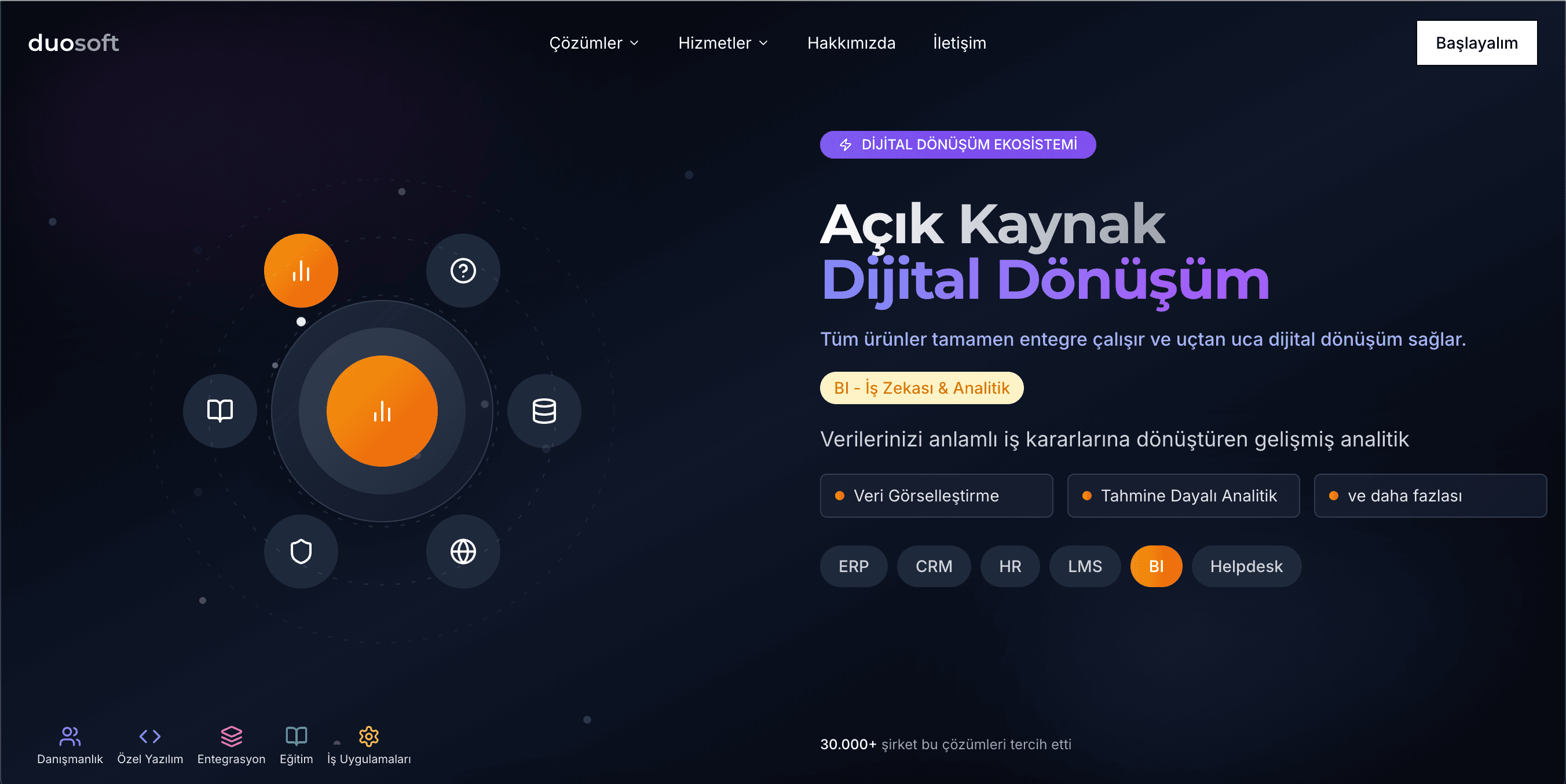
DuoSoft Yazılım
DuoSoft Yazılım specializes in guiding businesses through their digital transformation journey, offering comprehensive consulting, bespoke software development, and advanced AI solutions. Their services include strategic planning, process analysis, and the development of custom software tailored to unique business needs. They also provide corporate training programs to ensure efficient adoption of new digital tools and AI applications. DuoSoft focuses on optimizing business processes, generating value from data, and ensuring seamless integration with existing systems, supported by experienced consultants and continuous technical support.