
Research & Education
Browsing page 348 of AI tools for Research & Education. Sorted by confidence score — our independent quality rating.

Driving with Language
Driving with Language is a Hugging Face Space designed for users interested in AI competitions and language-based tasks. This application serves as a central hub for the AGC 2024 competition, enabling participants to view comprehensive competition details, access necessary datasets, and monitor their progress on leaderboards. Users can log in to submit new entries for evaluation, track the status of their submissions, and review their past performance. The platform aims to streamline the participation process for AI enthusiasts and researchers, offering a user-friendly interface for managing all aspects of their involvement in the competition.
DetectGPT: AI Detector
DetectGPT is a reliable AI detection tool designed to help users determine if content is human-written or AI-generated. Trained on billions of words, it boasts 95% accuracy across various AI models, including ChatGPT, GPT-4, and Gemini. Beyond detection, DetectGPT provides an AI Humanizer feature to rewrite text, helping content appear more human-like and bypass other AI detectors. It also offers Original Content Certification, allowing users to prove their content's authenticity. The platform includes a plagiarism checker, fact-checking capabilities (coming soon), and a readability score. DetectGPT is particularly useful for teachers ensuring academic integrity, students verifying originality, and writers maintaining content uniqueness. It supports over 50 languages and offers a free trial.
Valence Labs
Valence Labs, powered by Recursion, functions as an AI research engine dedicated to accelerating the mission of decoding biology to radically improve lives. The platform utilizes Recursion’s extensive data generation capabilities, including over 60 petabytes of phenomics and transcriptomics data, alongside its BioHive supercomputer for massive computing power. Valence Labs focuses on predicting cellular responses to perturbations, explaining molecular interactions, and discovering novel therapeutic hypotheses through lab-in-the-loop engines. This approach aims to build 'virtual cells'—mechanistic models of cellular function—to guide the discovery of new therapeutics and improve drug discovery outcomes.

DOMINUS Lab
DOMINUS Lab is a global Christian startup initiative dedicated to fostering entrepreneurship within the Christian community, with an ambitious goal to create 1,000 Christian AI startups. The platform provides a comprehensive ecosystem including a 'Startup School' for foundational knowledge, 'Startup Awards' to recognize innovation, and 'Startup Events' for networking and inspiration. It emphasizes that Christians may have an unfair business advantage and seeks to empower the next generation of Christian entrepreneurs to do well while doing good. The initiative also hosts 'DOMINUS Dinners' for community building and offers keynotes and workshops for universities, churches, and international roadshows, aiming to inspire and equip Christian founders.
Document Qa
Document Qa is an AI tool hosted on Hugging Face Spaces, designed for question answering based on document content, specifically arXiv papers. Users can import a paper by URL and then ask questions, receiving answers derived from the paper's summary. This tool utilizes a Gradio interface, making it accessible for interaction. It is licensed under Apache-2.0, indicating its open-source nature and suitability for research and educational purposes. The platform is currently sleeping due to inactivity, but when active, it offers a straightforward way to extract information from academic papers.
Lemmelingo: Language tracker on steroids
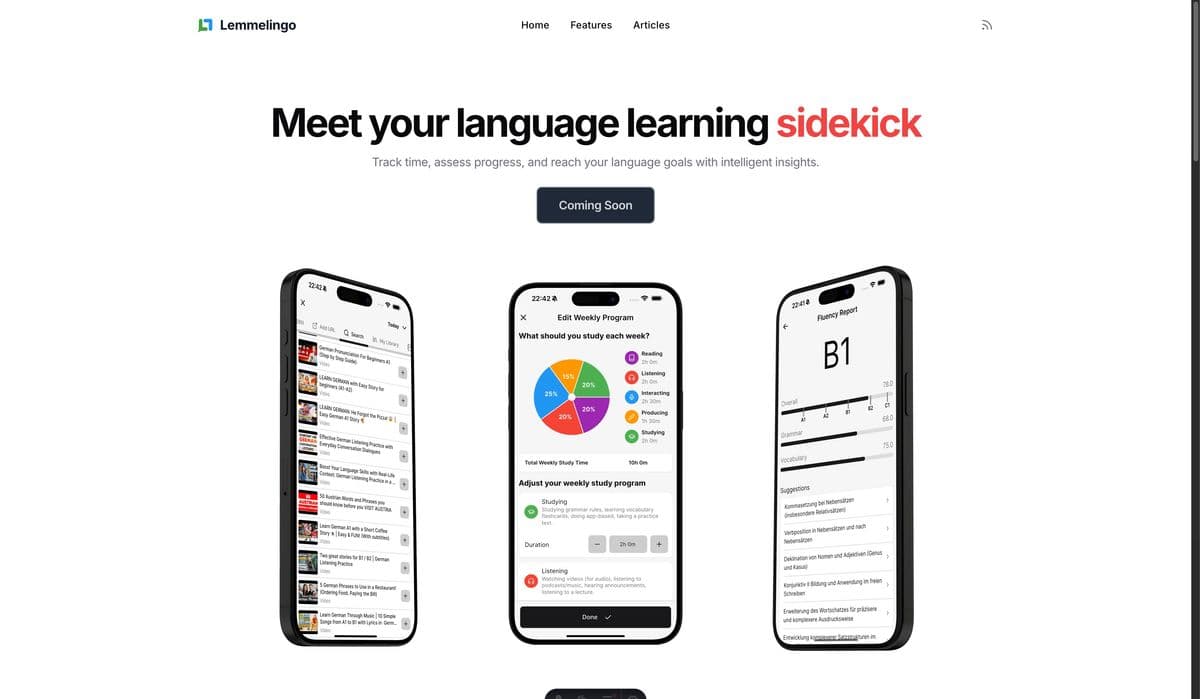
Lemmelingo is a language-learning app designed to help independent learners build consistent language habits. It provides personalized weekly lessons and exercises tailored to your level, goals, and schedule. Users receive instant corrections on grammar, spelling, and phrasing issues, along with guidance for improvement. The platform offers clear progress tracking through countdowns, streaks, heatmaps, and level trends, allowing users to visibly monitor their advancement. Lemmelingo supports English, German, Spanish, Italian, and French, and allows users to connect their own study materials like books, videos, and podcasts to integrate with their personalized learning path. The first cycle is free, with a subscription required for continued access.
GNN4Traffic
GNN4Traffic serves as a centralized repository for Graph Neural Network (GNN) resources specifically tailored for traffic forecasting. It compiles a wide array of academic papers, relevant code implementations, and datasets, making it an invaluable resource for researchers and practitioners in the field. The repository highlights significant works, including surveys and research progress in GNNs for traffic forecasting, and also features calls for papers for special issues in prominent journals. It aims to support the development and advancement of models for traffic prediction by providing easy access to cutting-edge research and practical resources.

Syloti App
Syloti App is an interactive learning platform dedicated to preserving and teaching the Syloti script, a unique Bengali script. Designed for all ages, the platform offers a comprehensive approach to language learning through engaging lessons with colorful illustrations and activities. Users can practice writing Syloti with interactive exercises that provide real-time feedback, ensuring effective learning. The app also incorporates fun games to help users practice Syloti letters and build vocabulary. Syloti App aims to make learning the Syloti script accessible and enjoyable, contributing to the preservation of this linguistic heritage.
Answer.AI
Answer.AI is an AI-powered platform designed to accelerate student success by offering 24/7 personalized tutoring and counseling. Available as a mobile app, web extension, and online tool, it supports students from high school through university with various academic needs. Key features include homework help, study group facilitation, college admissions guidance, and AP tutoring. Beyond academics, Answer.AI assists with common app essays, managing social anxiety, and collaborating with classmates. It offers customizable learning features like flashcards and quizzes, tracking progress to ensure student success. The platform aims to provide expert, ongoing support to help students excel in the classroom and beyond.
DeepSeek-Prover-V2-671B
DeepSeek-Prover-V2-671B offers a straightforward chat interface for interacting with the DeepSeek-Prover V2 large language model. After signing in with a Hugging Face account, users can input any question or prompt and receive an instantly generated response. This tool is particularly useful for exploring the capabilities of the DeepSeek-Prover V2 model, which is designed for code proving and model verification. It provides a hands-on way for developers, researchers, and AI enthusiasts to test and evaluate the model's performance in various scenarios, making it a valuable resource for those interested in code analysis and AI model interaction.

Virtual Sapiens AI
Virtual Sapiens AI is an advanced communication coaching platform that leverages AI roleplays to enhance leadership presence, sales performance, and team communication. It offers interactive scenarios for practicing pitches, handling difficult conversations, and leading meetings, with AI personas that adapt dynamically. The tool provides patented, real-time feedback on nonverbal communication, vocal tone, filler words, and verbal clarity, helping users reinforce real-world skills. It includes features like an In-Call Sidekick Coach, Practice Mirror, and Video Upload analysis. Designed for enterprise trust and privacy, Virtual Sapiens supports team programs with skills mapping and reporting, making it ideal for sales enablement, corporate training, and executive coaching.

Chegg
Chegg is a comprehensive education platform designed to support students with their academic needs. It offers 24/7 homework help, providing step-by-step textbook solutions and expert answers to specific questions. Beyond direct homework assistance, Chegg facilitates textbook rentals, helping students access necessary materials affordably. The platform also includes tools for writing and citations, a plagiarism checker, a grammar checker, and expert proofreading services to enhance academic integrity and quality. Additionally, Chegg provides a Math Solver and exam preparation resources, making it a versatile tool for students from their first assignment to final exams. The platform aims to improve learning outcomes by offering instant study help and a range of academic support services.
Depth Anything Web
Depth Anything Web is an AI-powered tool hosted on Hugging Face Spaces that provides real-time depth estimation from uploaded images. Users can easily submit an image file, and the application processes it to generate a detailed depth map, visually indicating which parts of the image are closer or farther away. This functionality is particularly useful for understanding spatial relationships within 2D images, offering a 3D-like perspective. The tool leverages the Xenova/depth-anything-small-hf model, making it a valuable resource for individuals involved in research, development, and educational pursuits within the fields of AI and computer vision. Its web-based interface ensures accessibility and ease of use for anyone looking to explore depth estimation without complex setups.
DocOwl
DocOwl is an AI-powered application designed to provide detailed explanations and answers from user-uploaded images and text. Users can interact with the tool by inputting text questions or uploading images, and the system will process these inputs to generate relevant responses. While the specific functionalities for document analysis and information extraction are not explicitly detailed in the current live content, the tool's core capability revolves around understanding and responding to visual and textual queries. The platform appears to be hosted on Hugging Face Spaces, suggesting an accessible web-based interface.
DoclingConverter
DoclingConverter is a Hugging Face Space designed to streamline the process of converting PDF documents into more structured and editable formats like Markdown or JSON. Users can upload a PDF file and then select their desired output format. The tool not only extracts the textual content but also captures relevant metadata, making it highly useful for various applications. This simplifies document processing for tasks such as content management, data extraction, and archival. It is particularly beneficial for individuals and professionals who frequently work with PDFs and require an efficient way to transform them into machine-readable or easily editable formats.
Detoxified Lms
Detoxified Lms is an AI-powered content moderation tool specifically developed to filter and detoxify online learning materials. Its primary function is to identify and remove harmful or inappropriate content, thereby fostering safer online educational environments. The tool is designed to assist in maintaining the integrity and safety of digital learning platforms by ensuring that the content presented to users is free from toxic elements. While the current live website indicates a runtime error, the intended purpose of Detoxified Lms is to provide a solution for content moderation within the educational technology space, contributing to a more secure and positive learning experience.
DETA
DETA is a Hugging Face Space developed by hysts, designed for object detection and labeling within images. Users can upload an image and specify a confidence threshold, after which the application processes the image to identify and highlight objects, displaying their corresponding labels. This tool is particularly useful for tasks requiring visual analysis and object identification, making it suitable for educational projects, research, or applications where automated object recognition is beneficial. It operates as a web application, providing an accessible platform for image analysis.
CuriousBox.ai
ProdE is a planning layer built for agentic development, designed to bridge the gap between product ideas and code-ready specifications. It enables PMs and engineers to collaborate on living specs that are directly grounded in their codebase, eliminating rework and missed deliveries. The tool extracts ideas from customer calls, ranks them by business impact, and generates PRDs with instant risk surfacing. It then creates detailed product, UI/UX, and engineering specs that are coding-agent-ready. ProdE also provides automated technical documentation, change impact analysis, and a codebase chat for Q&A, all while supporting multi-repo and microservices architectures. It integrates with existing tools like GitHub, Jira, and various coding agents via an MCP server.

Doc2Exam
Doc2Exam is an AI-powered platform designed to streamline the process of creating exams from various materials. It serves both students who are preparing for tests and professors or educators responsible for setting official certifications. The tool automates the generation of diverse exam questions, transforming study materials into interactive assessments. This capability makes exam preparation more efficient for students and simplifies the test creation workflow for instructors, ensuring that the generated exams are relevant and comprehensive based on the provided content.
python-is-cool
Python-is-cool is an open-source guide curated by Chip Huyen, designed to introduce Python features that are particularly useful for machine learning but might be less commonly understood or utilized. The guide covers topics such as lambda functions, map, filter, and reduce, demonstrating their application with practical code examples. It also delves into advanced list manipulation techniques, including unpacking, slicing, insertion, and flattening, alongside a comparison of lists versus generators for efficient memory usage. Furthermore, the resource explains Python's magic methods (dunder methods) for customizing class behavior, such as `__repr__`, `__eq__`, and `__slots__`, enhancing object representation and comparison. This resource is ideal for developers looking to deepen their Python knowledge for machine learning applications.

Thousand Brains Project
The Thousand Brains Project is an open-source initiative dedicated to rethinking AI from the ground up, drawing inspiration from the neocortex. It aims to build a general-purpose system for modeling sensorimotor data, rather than static datasets, making it highly applicable to robotics and even abstract sensorimotor tasks like navigating the web or processing language. The project emphasizes energy and data efficiency, continuous learning, and modularity, allowing for flexible architectures. Unlike current AI approaches, it focuses on learning through active interaction with the world, similar to how humans learn. The project is funded by Jeff Hawkins and the Gates Foundation, and it provides open-source code, research meeting recordings, and documentation for community involvement.
tutor.new
tutor.new is an AI-powered tutoring platform designed to help students learn effectively across a wide range of subjects, including mathematics, physics, German, English, history, and biology. Users can upload photos of worksheets or describe their learning needs to the AI, which then provides patient explanations and helps solve problems through voice or text chat. A key differentiator is its 'Learn-to-Earn' reward system, where students collect valuable coins for learning progress, which can then be exchanged for digital awards or physical rewards shipped to their homes. The platform offers flexible pricing with prepaid hours or weekly subscriptions, catering to students, parents, schools, and lifelong learners. It also features personalized tutors, interactive visualizations, automatic notes, and quizzes to enhance the learning experience.
PythonNumericalDemos
PythonNumericalDemos is an open-source repository designed to provide Python demonstrations for spatial data analytics. It encompasses a range of topics, including geostatistical and machine learning workflows, making it a valuable resource for both students and educators. The repository is specifically tailored to support courses in data analytics and geostatistics, helping users overcome intellectual hurdles in data science. By offering practical, code-based examples, PythonNumericalDemos facilitates a deeper understanding of complex numerical methods and their application to real-world spatial data problems. Its open-source nature encourages collaboration and continuous improvement within the data science community.
deep-learning-for-image-processing
Deep-learning-for-image-processing is an open-source educational resource designed to help users understand and implement deep learning techniques for image processing. It offers comprehensive tutorials and practical implementations across various domains, including image classification, object detection, semantic segmentation, instance segmentation, and keypoint detection. The resource leverages popular frameworks like PyTorch and TensorFlow (specifically Keras module in TensorFlow2) to demonstrate network architectures and training processes. It includes detailed explanations of models such as LeNet, AlexNet, VggNet, ResNet, YOLO series, FCN, DeepLabV3, Mask R-CNN, and DeepPose. All course materials, including PPTs and code, are provided, making it a valuable asset for students and researchers in the field.